 Ultimate guide
Planning a Bespoke Gorilla Trekking Trip: Full Guide
Last Updated: October 29, 2026
Quick Summary
A gorilla trekking trip is best planned by first choosing between Uganda and Rwanda, then booking permits early, since they sell out in advance. Build your itinerary around the permit date, and ask each operator for an itemised quote showing the official permit rate separately.
- Choose Uganda's Bwindi for a longer, more immersive stay, or Rwanda's Volcanoes for quicker access from Kigali.
- Book permits well in advance, particularly for busy travel periods, because availability is limited.
- Ask every operator to quote the permit as a standalone line at the official source rate.
- Work backwards from your permit date and build in a spare day for weather or gorilla movements.
- Pack waterproof hiking boots, long layers, a waterproof jacket and gloves for wet, steep forest terrain.
Table of Contents
- Choosing Between Uganda and Rwanda for Your Gorilla Trek
- How Far in Advance to Book Your Gorilla Trekking Permits
- A Transparent Budget for Your Gorilla Trekking Trip
- Building a Gorilla Trekking Itinerary Around Your Group
- Gorilla Trekking Fitness Requirements and Trek-Day Contingencies
- Gorilla Trekking Packing List and Essential Gear
- Choosing a Licensed Operator and Booking Your Gorilla Trek
- Frequently Asked Questions
Choosing Between Uganda and Rwanda for Your Gorilla Trek
Gorilla trekking is offered in two countries that protect mountain gorilla populations: Uganda and Rwanda. Both protect mountain gorilla populations, but the experience differs in ways that matter for your group. The right choice depends on your travel dates, your budget, and how much time you have.
Uganda's Bwindi Impenetrable National Park tends to suit travellers who want a longer, more immersive stay. It is a dense forest with varied terrain, and treks can be more physically demanding.
Neither destination is objectively better. The decision usually comes down to logistics. Combining both countries is possible, but it adds travel days and should only be considered if your group has the time and the stamina for longer transfers.
How Far in Advance to Book Your Gorilla Trekking Permits
Permits are an important booking decision in a gorilla trekking trip, and availability is limited. Popular dates can sell out well in advance, particularly during the dry seasons.
A practical timeline works backwards from your travel dates. Booking permits well in advance is generally advisable, particularly for busy travel periods. Once permits are confirmed, your itinerary can be built around them rather than the reverse.
A Transparent Budget for Your Gorilla Trekking Trip
Pricing depends on your choices, including dates, group size, accommodation level and the services you select. Below is the structure we use to build every quote, with the levers you control and the questions to ask so you can compare proposals on a like-for-like basis.
The six cost lines in every gorilla trekking budget
- Permits. Set by the national park authority, not by the operator, and priced per person per trek. Permits in each country are issued by the relevant national authority, which publishes current rates. Always ask for the permit cost as a separate line so you can verify it against the official rate.
- Accommodation. Usually quoted per person per night on a full-board basis near the park. Lodges range from simple guesthouses to high-end forest lodges, so accommodation level is a major factor in total cost.
- Ground transport. A private 4x4 with driver-guide, fuel and park entry for the vehicle. This is a fixed cost per vehicle, so it falls per person as the group grows, one of the few lines where a larger group genuinely saves money.
- Internal flights and transfers. The drive from Entebbe to Bwindi is long (typically a full day each way), so many travellers take a light aircraft to a nearby airstrip. Kigali to Volcanoes National Park is a short road transfer by comparison.
- Meals, park fees and optional activities. Usually bundled into the accommodation rate, but confirm what is excluded, drinks, laundry, community visits, golden monkey tracking, canoeing or a second gorilla trek.
- International flights, visas, insurance and tips. Booked separately or quoted as an add-on. Trekking guides and porters are usually tipped, so it is worth budgeting for them.
How the total changes with your choices
- Destination. Permit costs differ between the two countries, and Rwanda's shorter transfer from Kigali can reduce travel time and internal-flight costs. Uganda rewards travellers with more days to spend.
- Trip length. A two-night trip is permit-heavy; a five-night trip spreads transport and guiding across more days, so the per-day cost usually falls even though the total rises.
- Group size. Permits and accommodation scale per person; vehicle and guide costs do not. Larger groups share fixed vehicle and guide costs, which can reduce the cost per person.
Questions that expose a vague quote
- Is the permit included, and at what official rate?
- How many nights, and is it full board or bed and breakfast?
- Is the vehicle private, and does the price include fuel and driver allowance?
For a current, itemised quote matched to your group, dates and comfort level, enquire with Isba African safaris.
The table below summarises the six cost lines the article uses to build every gorilla trekking quote.
| Cost line | What it covers | Note |
|---|---|---|
| Permits | Set per person per trek by the national park authority | Ask for it as a separate line |
| Accommodation | Per person per night, usually full board | Biggest discretionary lever |
| Ground transport | Private 4x4, driver-guide, fuel and park entry | Fixed per vehicle, falls per person as group grows |
| Internal flights and transfers | Light aircraft to Bwindi or short road transfer in Rwanda | Entebbe to Bwindi is a long drive |
| Meals, park fees and optional activities | Often bundled into accommodation rate | Confirm exclusions such as drinks and laundry |
| International flights, visas, insurance and tips | Booked separately or quoted as an add-on | Budget for guide and porter tips |
Building a Gorilla Trekking Itinerary Around Your Group
A bespoke itinerary is planned around your own priorities rather than a standard template. It is a sequence of days built around a fixed, non-negotiable anchor: your permit date. Everything else, flights, lodges, rest days, add-ons, flexes around it. Below are the patterns we use most often, so you can see what different trip lengths and starting points actually look like.
The anchor principle
Permits are typically tied to a specific date and trekking sector. Once that date is confirmed, work backwards: arrival day, acclimatisation day, trek day, recovery day, departure. Build in a spare day wherever your schedule and budget allow, because weather, road conditions and gorilla movements can all shift a trek. A spare day is the cheapest insurance in gorilla trekking.
Sample itineraries by length
Four nights, the short bespoke trip (Rwanda)
- Day 1: Arrive Kigali, transfer to Volcanoes National Park (roughly two to three hours by road), afternoon at leisure.
- Day 2: Acclimatisation and optional activities, golden monkey tracking, a community visit or a forest walk.
- Day 3: Gorilla trekking day. Early briefing, trek, one hour with the gorillas, return to the lodge.
Six nights, the classic Uganda trip
- Day 1: Arrive Entebbe, overnight near the airport.
- Day 2: Light aircraft to the Bwindi area, transfer to lodge.
- Day 3: Acclimatisation and community or forest walk.
Nine nights, trekking plus safari
- Days 1-6: As the six-night Uganda pattern above.
- Days 7-9: Transfer to Queen Elizabeth National Park for game drives and a Kazinga Channel boat trip, then return to Entebbe.
Variants for different travellers
- Mixed fitness levels. Put the trek on the day after an acclimatisation day, and pair it with a lighter activity the following day. Non-trekking companions can usually join community visits, tea estate tours or lodge-based walks.
- Families with younger travellers. Check minimum age rules with the park authority before booking, permits are not issued below the published age threshold, and keep transfer days short.
- Travellers with mobility or health needs. Raise this at enquiry stage, not on arrival. Where conditions allow, a shorter trek may be possible, and porter support can be discussed when planning. Be specific about distances, terrain and altitude tolerance so the right sector can be requested.
Realistic add-ons and the time they cost
- Second gorilla trek. One extra full day plus a second permit. Worth it if photography is the priority.
- Golden monkey tracking. Half a day in Rwanda; a gentle complement to the main trek.
- Savannah safari. Two to three nights minimum. Queen Elizabeth National Park pairs well with Bwindi; Akagera pairs with Volcanoes National Park.
If you are travelling with family or a larger group, our guide on planning a multi-generational safari itinerary walks through how to balance the pace for different ages and interests. Tell us your dates, group and comfort level and we will draft a day-by-day outline around your permit.
Gorilla Trekking Fitness Requirements and Trek-Day Contingencies
Gorilla trekking involves walking through forest and up steep, often muddy slopes, and the time spent with the gorillas is limited to one hour (Mountain gorilla tracking).
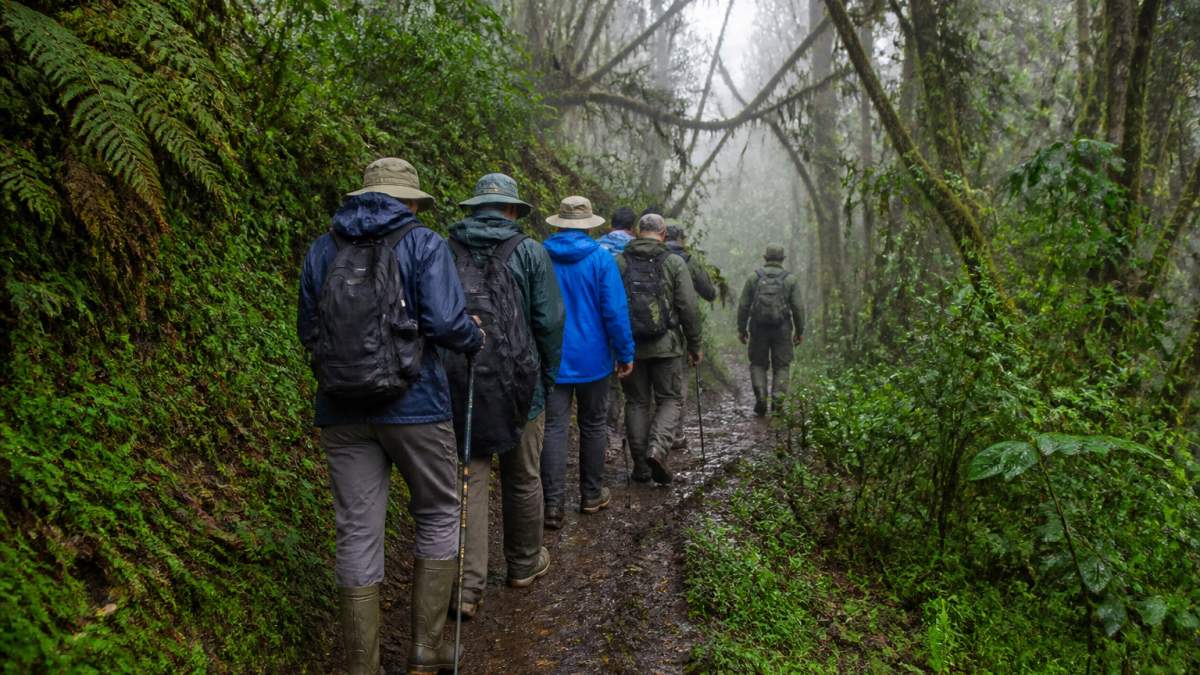
A small group of hikers walking through a misty forest trail with a guide ahead gives a sense of the terrain you should expect.
!Small group of hikers in waterproof jackets walking through a misty green forest trail with a guide ahead
If you are unsure whether the trek suits your fitness level, our guide to matching a safari to different fitness levels explains the options.
Preparing for Steep Terrain and Altitude
Terrain in both Uganda and Rwanda is steep and can be slippery after rain. Good hiking boots with strong grip, waterproof outer layers, and gloves for grabbing vegetation will make a real difference. Altitude is also a factor in the volcanic highlands, so allow a day or two to acclimatise before a demanding trek.
Gorilla Trekking Packing List and Essential Gear
Pack for wet, cool conditions in the forest, even if the weather near the lodge is warm. Essentials include waterproof hiking boots, long trousers, long-sleeved layers, a waterproof jacket, gloves, a daypack, a rain cover, and a reusable water bottle. Bring a camera with spare batteries, but remember that flash photography is not permitted near the gorillas.
Check current park rules before you travel, as requirements can be updated by the authorities.
Choosing a Licensed Operator and Booking Your Gorilla Trek
Choose an operator with experienced, locally trained guides. At Isba African safaris, our team of bilingual, locally trained guides supports your trip, and we respond to enquiries within 24 hours. You can compare the best private safari guides in Africa before you book your trek.
To start planning your bespoke gorilla trek, enquire for a tour booking with Isba African safaris. For help choosing the right time of year, see our guide to the best months for African wildlife viewing, and for a wider view of planning a tailored trip, read how to plan a bespoke African safari.
Frequently Asked Questions
How do you plan a bespoke gorilla trekking trip?
Start by deciding between Uganda and Rwanda, then set your travel dates, as permits are limited and sell out. Confirm how many days you can allow, including flights and ground transfers. Share your group's fitness levels and interests with your planner so the itinerary can be adjusted for everyone, from first-time trekkers to older relatives. A tailor-made plan can be shaped around your preferences, including accommodation and any add-ons such as other wildlife experiences.
How far in advance should you book a gorilla trekking permit?
Book your gorilla trekking permits as early as you can, ideally many months before travel, because daily permit numbers are capped and popular dates in the dry season sell out quickly. Permit availability varies by country and season, so check current availability with your operator before fixing flights. Booking early also gives you time to rearrange dates if the first choice is full.
How many days should you allow for a gorilla trekking trip?
Most gorilla trekking trips include at least two to three days in the park area, with extra days for travel between the airport and the park and for any other safari activities you add. Allow additional time if you are combining Uganda or Rwanda with another destination. A longer schedule gives trek-day contingencies room, such as a weather delay or a slower group member, without cutting the trek short.
What should you pack for gorilla trekking?
Pack sturdy waterproof hiking boots with good grip, long trousers, long-sleeved layers, a waterproof jacket, gloves and gaiters for muddy slopes. A walking stick is useful on steep terrain. Bring a small daypack with water, a camera, insect repellent and a rain cover for your electronics. Your operator will confirm any specific rules, such as minimum age, mask use or distance from the gorillas, before you travel.
How physically demanding is gorilla trekking?
Gorilla trekking involves hiking over steep, muddy and sometimes slippery terrain through dense forest, and the time to reach the gorillas varies from under an hour to several hours. You should be reasonably fit and comfortable walking for several hours on uneven ground. Guides can help with pace and the time spent with the gorillas is limited, so it is worth preparing with regular walking before your trip.
What is the difference between gorilla trekking in Uganda and Rwanda?
Uganda's main gorilla trekking areas are in Bwindi Impenetrable National Park, which is known for its dense, varied forest and several habituated groups. Rwanda's gorillas live in Volcanoes National Park, which sits within the Virunga Mountains and is often reached by a shorter drive from Kigali. Permit prices, trek difficulty and the overall trip cost differ between the two, so compare them against your group's dates, budget and fitness level.
How can you make a gorilla trekking safari more comfortable?
Choose accommodation close to the trekking headquarters to reduce early starts and long drives. Consider private transport and a guide who can adjust the pace to suit older or less fit group members. Ask for a clear itinerary with rest days, and pack light so you can manage your own bag on the trail. Comfort also comes from a transparent budget, so you know what is included before you arrive.
What should you look for when choosing a gorilla trekking guide or operator?
Look for an operator with experienced, locally trained guides who know the trekking sectors and the gorilla groups. Ask how they handle group sizes and how they respond to changes or emergencies, and request a clear breakdown of what is included in the price before booking.