 Listicle
Best 4x4 for African Safari Expeditions: A Buyer's Guide
Last Updated: November 8, 2026
Quick Summary
The best 4x4 for African safari expeditions depends on your destination, terrain and group size. For most guided road-based safaris, a closed 4WD such as a Toyota Land Cruiser with a pop-top roof is the standard choice, while self-drive travellers on a tighter budget may choose a rental 4x4 with adequate clearance and recovery kit.
- Closed 4WD vehicles with pop-top roofs are the most common choice for guided road-based safaris.
- Self-drive trips need at least 200 mm ground clearance, a low-range transfer case and sand or mud tyres.
- Botswana's deep Kalahari sand and Okavango water crossings demand recovery points and a snorkel.
- South Africa's tarred roads mean a lighter SUV or double-cab can be adequate.
- Check park rules before booking, as some destinations restrict off-road and night driving.
Table of Contents
- Which 4x4 Suits an African Safari Expedition?
- Types of Safari Vehicles and How They Differ
- Toyota Safari Vehicles: Land Cruisers, Prados and Hiluxes Compared
- Matching a 4x4 to Your Destination and Terrain
- Self-Drive Safari Vehicle Requirements
- Checklist for Choosing an Expedition-Ready 4x4
- Booking Your Vehicle with Isba African Safaris
- Frequently Asked Questions
Which 4x4 Suits an African Safari Expedition?
Choosing the best 4x4 for African safari expeditions depends mainly on where you travel, how you travel and how many people are in your group. A closed 4WD with a pop-top roof suits most road-based safaris, while a rental 4x4 can suit self-drive travellers on a tighter budget. Starting with your route and seating needs before comparing models is a sensible approach.
Finding the best 4x4 for African safari expeditions involves more than choosing the vehicle itself. Terrain, road conditions, passenger comfort and the level of guiding support all shape which option works best. The sections below set out the main categories so you can match a vehicle to your own trip.
Types of Safari Vehicles and How They Differ
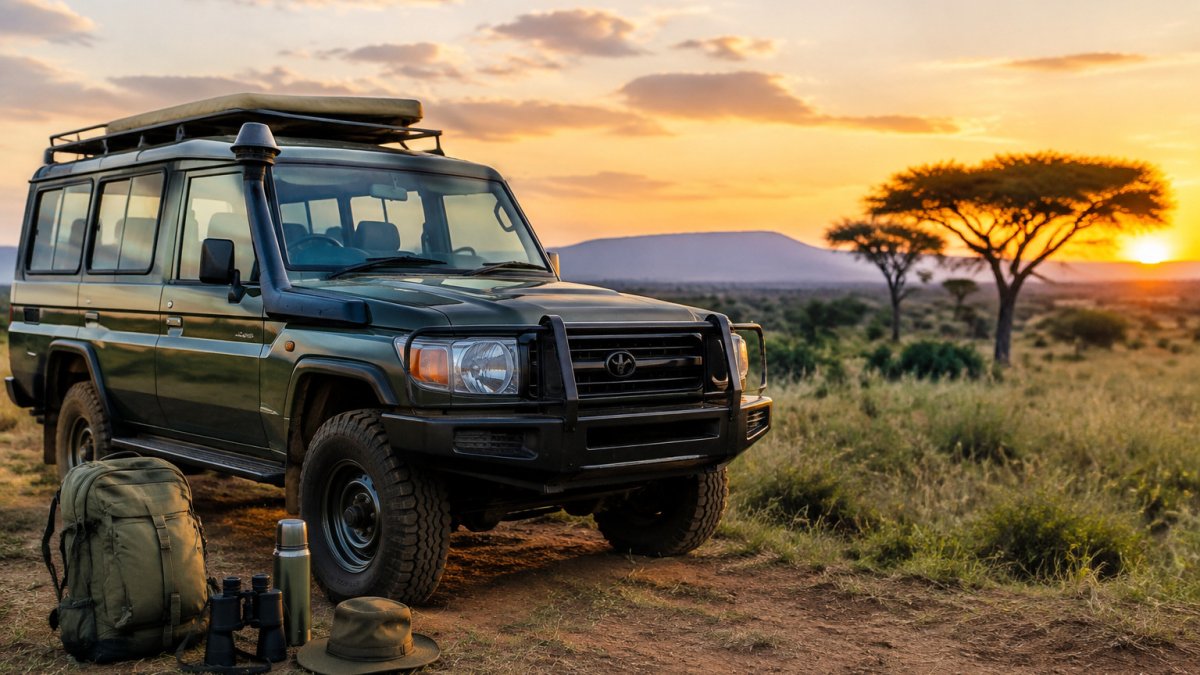
Safari vehicles fall into a few broad groups. Closed 4WD vehicles, often based on a Toyota Land Cruiser, are the most common for guided road-based safaris. They offer shelter from dust and weather and usually include a pop-top roof for standing viewing.
Open-sided and overland vehicles serve different needs. Open-sided models give unobstructed sightlines, while overland trucks carry more gear for long, remote journeys.
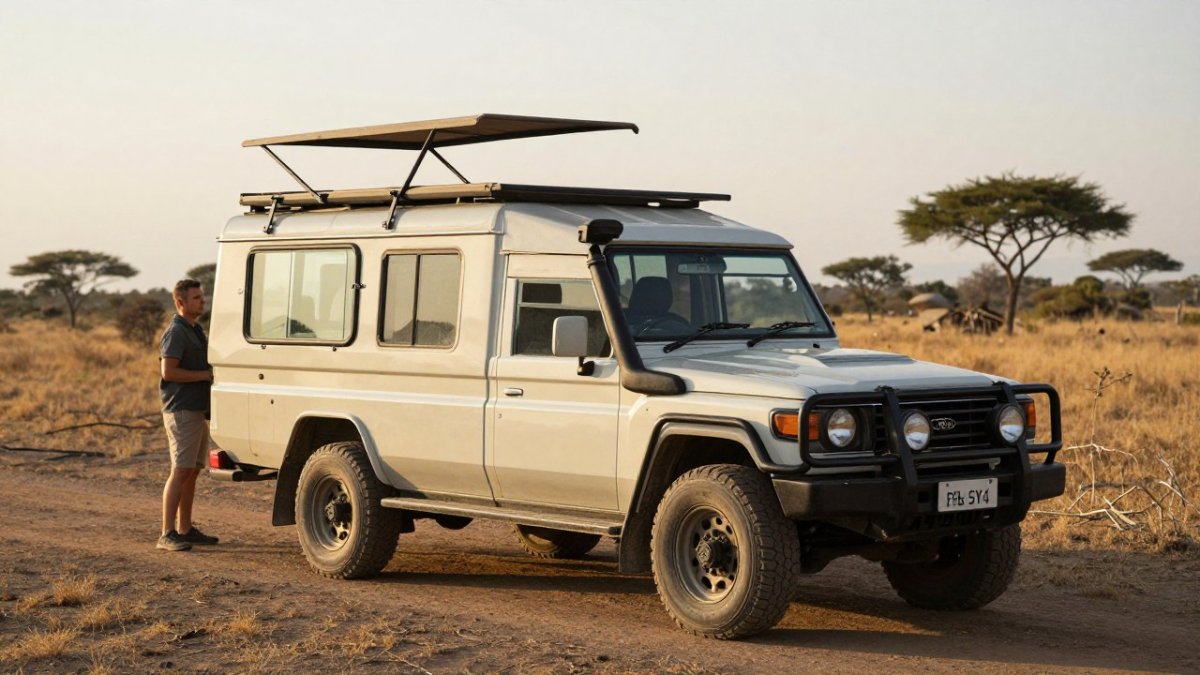
Toyota Safari Vehicles: Land Cruisers, Prados and Hiluxes Compared
Toyota models feature heavily in African safari travel, but they serve different roles.
The Land Cruiser Prado and Hilux appear more often in self-drive rental fleets.
Matching a 4x4 to Your Destination and Terrain
No single 4x4 is best across every African safari destination. Terrain, park regulations and road conditions vary enough that the right choice in one country can be the wrong one in another. The table below sets out how the main destinations shape vehicle choice, followed by the terrain factors that matter most.
| Destination | Typical terrain and roads | Vehicle considerations |
|---|---|---|
| Kenya | Dusty tracks, murram roads, seasonal mud in the Mara | Closed Land Cruiser with pop-top roof; high clearance and reliable cooling |
| Tanzania | Long gravel transfers, rocky tracks in the Crater highlands, sand in Ruaha | Land Cruiser or similar; low-range gearing for steep crater access |
| Botswana | Deep sand in the Kalahari and Okavango, water crossings in the Delta | Tyre pressure management, recovery points, snorkel for water crossings |
| South Africa | Tarred park roads in Kruger, rocky tracks in private reserves | Lighter 4x4 or SUV can suffice; raised viewing position still valuable |
| Namibia | Gravel, corrugated roads, remote desert tracks | Durability, spare tyres, long-range fuel capacity |
In Kenya, closed 4WDs with pop-top roofs are the standard for guided road safaris, and the Land Cruiser dominates because parts and mechanics are widely available. Tanzania places similar demands on vehicles, but the steep access roads into the Ngorongoro Crater reward low-range gearing and strong brakes. Botswana is the opposite extreme: deep Kalahari sand and Okavango water crossings punish vehicles without recovery points, a snorkel or the ability to air down tyres. South Africa is more forgiving, with tarred roads through Kruger and graded tracks in many private reserves, so a lighter SUV or double-cab can be adequate. Namibia's gravel and corrugated desert roads favour durability and long-range fuel capacity over outright off-road ability.
Beyond the destination, four terrain factors should drive your choice. Once you have a vehicle in mind, you can also learn practical ways to maximise wildlife sightings from it. Ground clearance determines whether you can clear rocky tracks and rutted mud without grounding. Low-range gearing matters on steep crater access and in deep sand. Differential locks and traction control help in mud and sand but are only useful if the tyres suit the surface. Water crossings demand a raised air intake and a clear recovery plan.
Timing matters too. Dry-season roads are generally easier than rainy-season tracks, so check the best months for your planned route before you choose a vehicle. Land Rovers are also used for raised wildlife viewing in parks such as Kruger National Park, and their lighter weight can be an advantage on soft sand.
Watch out: park rules in some destinations restrict off-road driving and night driving, so confirm what your vehicle is actually permitted to do before you book a model that only makes sense off-track.
Self-Drive Safari Vehicle Requirements
Self-drive travel places more responsibility on you, and the vehicle specification matters more than it does on a guided trip because there is no operator to fall back on. You can see what rental support and essentials are typically provided with a self-drive vehicle. Rental 4x4s used for self-drive trips require you to handle navigation, breakdowns and park rules yourself. The checklist below covers what to confirm before you book and what to carry.
Vehicle specification to confirm
- Ground clearance of at least 200 mm for rocky tracks and rutted mud
- Low-range transfer case and, where possible, a rear differential lock
- Tyres suited to sand or mud, with a matching spare and a working jack
- Raised air intake if your route includes water crossings
- Long-range fuel capacity or confirmed refuelling points on your route
- Air conditioning and sealed cabin for dust and heat
- Roof rack or trailer capacity for water, fuel and camping gear
Recovery and safety kit to carry
- Recovery points front and rear, rated shackles and a tow strap
- Traction boards or sand ladders for sand and mud
- Tyre pressure gauge and compressor for airing down and reinflating
- First-aid kit, fire extinguisher and a full water reserve
- Satellite messenger or personal locator beacon where mobile coverage is absent
- Paper maps and a charged GPS, plus a printed itinerary left with a contact
Paperwork and permissions
Confirm that your rental agreement covers cross-border travel if your route crosses into another country, and check whether the insurer requires an additional cross-border letter. Carry your licence, vehicle registration, insurance documents and any park permits in the vehicle. Some parks require a permit to be shown at the gate, and some border posts require a temporary import permit for the vehicle.
Breakdown and communications planning
Before you leave, record the rental company's emergency number, the nearest workshop on your route and the contact details for park rescue services. If you are unsure about your experience with rough terrain, a guided vehicle may suit you better than self-drive.
Watch out: rental insurance often excludes damage from water crossings, underbody damage and tyre damage, so read the excess and exclusions before you commit to a route that includes those conditions.
Checklist for Choosing an Expedition-Ready 4x4
Use this checklist when comparing vehicles:
- Seating capacity matches your group size, including luggage
- Ground clearance suits your planned routes
- Air conditioning and reclining seats for passenger comfort
- Pop-top or raised roof for wildlife viewing
- Spare tyre, jack and recovery equipment included
- Clear rental terms covering insurance and breakdown support
- Fuel and camping gear arrangements confirmed
- Operator contact details and emergency procedure understood
Total expedition costs extend beyond the daily vehicle rate. Factor in fuel, park fees, insurance excess and any driver or guide costs when comparing options.
Booking Your Vehicle with Isba African Safaris
Isba African Safaris runs its own fleet of 4x4 Land Cruisers and minibuses, with bilingual, locally trained guides. Its tailor-made planning covers solo travellers, groups, fully independent travellers and self-drive trips, and it responds to enquiries within 24 hours.
Pricing depends on vehicle type, dates, group size and itinerary, so we recommend requesting a quote directly from Isba African Safaris for current rates. If you would also like a driver or accompanying guide, you can compare private safari guides in Africa. Our team can help you match the right vehicle to your destination and terrain. You can also browse luxury safari lodges across Africa that pair well with a vehicle-based itinerary.
Planning an expedition across Africa comes with real questions about vehicles, routes and support. Isba African Safaris can help you choose the right 4x4 and build an itinerary around it. Enquire for tour booking today to discuss your trip.
Frequently Asked Questions
Which tour company is best for an African safari?
The right operator depends on your travel style, group size and budget. Isba African Safaris builds tailor-made itineraries, runs its own fleet of 4x4 Land Cruisers and minibuses, and provides bilingual, locally trained guides for group, FIT, solo and self-drive trips. Its team responds to enquiries within 24 hours. Pricing depends on dates, vehicle choice and itinerary length, so request a quote from the Isba African Safaris website for current figures.
What is the best 4x4 safari vehicle?
For road-based safaris in Kenya and Tanzania, a closed 4WD with a pop-top roof, typically a Toyota Land Cruiser, gives the best mix of wildlife viewing height, shelter and off-road ability. Vehicle choice should follow the terrain on your route, the number of passengers and how much luggage you carry.
Is a 4x4 necessary for an African safari?
On most established safari routes, a 4x4 is essential because park tracks become muddy, rocky or sandy and river crossings can occur without warning. Off-road capability also lets you get close to wildlife away from the main roads. Some fly-in safaris and lodge-based transfers use other vehicles, but game drives in national parks are almost always carried out in a 4WD or a purpose-built safari vehicle.
Are open-sided or enclosed 4x4s better for wildlife viewing?
Open-sided vehicles give unobstructed sightlines and easier photography, but they expose passengers to dust, sun and weather. Enclosed 4WDs with a pop-top or raised roof offer a good compromise: shelter, air conditioning on some models, and height for viewing over bush. Choose open-sided vehicles for photography-focused trips in dry seasons, and enclosed vehicles for longer days, mixed weather or families with children.