 How-to
Safari Logistics for Solo Travellers: A Practical Guide
Quick Summary
Solo safari logistics means booking in the right order: dates and budget first, then destinations, lodges and transport, starting about 12 months ahead for peak dry-season trips. Solo travellers should expect to pay more per person because of single supplements, and should compare itemised quotes carefully.
- Confirm dates, passport validity and travel insurance around 12 months out
- Book internal flights, lodges and guides between 6 and 9 months out
- Ask whether charter seats can be shared with other guests to reduce cost
- Build a spare night at the start and end of the safari to protect connections
- Request a full itemised quote in writing, as headline prices may exclude park fees
Table of Contents
- Planning Your Solo Safari Timeline, Step by Step
- Choosing a Destination and Operator Who Suit Solo Travellers
- Solo Safari Safety: What Support You Should Expect
- Getting There: Transfers, Internal Flights and Fly-In Options
- Solo Safari Costs and Single Supplements Explained
- Group Safari for Solo Travellers Versus a Private Guide
- Booking Your Solo Safari With Isba African Safaris
- Frequently Asked Questions
Planning Your Solo Safari Timeline, Step by Step
Last Updated: November 6, 2026
Planning a safari alone takes more lead time than most travellers expect. Safari planning generally benefits from starting well ahead of your trip, especially for peak dry-season dates. Good solo safari logistics for solo travellers depend on booking the right things in the right order.
Start with your dates and your budget. Then choose your countries, lodges and transport. Each choice shapes the next one, so the order matters.
- 12 months out: Confirm your dates, passport validity and travel insurance
- 9 to 12 months out: Speak with a safari operator and shortlist destinations
- 6 to 9 months out: Book internal flights, lodges and guides
- 3 to 6 months out: Arrange vaccinations, visas and medical checks
- 1 to 3 months out: Confirm transfers, pack and review your itinerary
Watch out: Peak season can book up quickly, so late bookings may leave fewer lodge options.
Choosing a Destination and Operator Who Suit Solo Travellers
Choosing the right destination matters more when you travel alone. Some parks suit a first safari, while others involve longer drives and remote transfers.
Look for an operator with its own vehicles and experienced local guides. Ask how many guests share each vehicle. Ask whether your group stays separate from other tourists.
Consider asking these questions before you book:
- How experienced are the guides, and how long have they worked in the parks?
- Do you run your own vehicles, or do you rent them?
- Can you keep my group separate on game drives?
- How quickly do you reply to enquiries?
- What happens if my itinerary changes?
Solo Safari Safety: What Support You Should Expect
Safety is a common concern for solo travellers. A good operator should give you clear support from arrival to departure.
A good operator should be able to explain its support arrangements, including contacts, emergency procedures and briefings.
Getting There: Transfers, Internal Flights and Fly-In Options
Getting to a remote lodge is rarely a single journey. A typical solo itinerary chains an international flight, an internal scheduled flight or charter, and a final road or airstrip transfer. Each link has different luggage rules, reliability and cost, and the weakest link sets the pace of your whole trip.
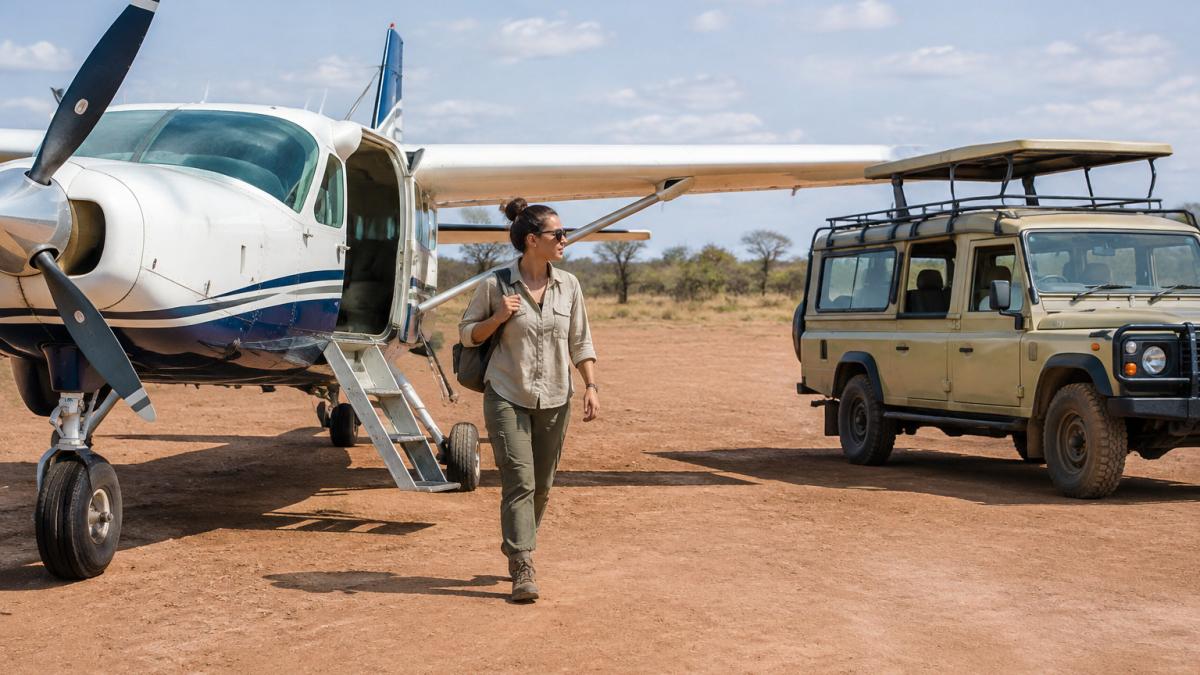
Compare the main options on the dimensions that actually affect a solo traveller:
- Scheduled internal flights: Often a practical way to cover long distances, but departures may run only a few days a week and timings are fixed. Luggage allowances on light aircraft are usually restricted, so check the allowance before you pack.
- Charter flights: Often faster and more flexible on timing and routing, but they are commonly priced per aircraft, so ask whether seats can be shared with other guests.
- Road transfers: Can be a practical option over shorter distances, though journey times on rough tracks can be considerably longer than on tarmac.
- Fly-in safaris: Combine scheduled or charter flights with airstrip pickups to cut travel time. They suit short trips and solo travellers who want to maximise time in the bush, but the luggage limit is the tightest of any option.
A practical booking sequence helps. Book international flights first, then internal flights once your lodge dates are confirmed, then transfers last so they match your actual arrival times. Give your operator your flight numbers and arrival times in writing, and ask them to confirm in writing who meets you at each point.
Watch out: Missed connections can disrupt solo itineraries. Where you can, build a spare night at the start and end of the safari, and confirm in writing who is responsible for rebooking a transfer if a flight is delayed.
For arrival logistics, ask your operator whether an airport meet-and-greet is included, how you will get a local SIM card or eSIM, and whether cash or card is expected at each stop. Share your full itinerary and a 24-hour contact number with a trusted contact at home before you fly.
The article compares the main ways to reach a remote lodge, and the table below sets out the key difference for each.
| Option | Best for | Key difference |
|---|---|---|
| Scheduled internal flights | Covering long distances | Departures may run only a few days a week |
| Charter flights | Faster, flexible timing and routing | Usually priced per aircraft, so ask about shared seats |
| Road transfers | Shorter distances | Journey times on rough tracks can be considerably longer |
| Fly-in safaris | Short trips and maximising time in the bush | Tightest luggage limit of any option |
Solo Safari Costs and Single Supplements Explained
Solo travellers usually pay more per person than couples or groups because lodges price most rooms and tents for two. A single supplement is generally the difference between the per-person shared rate and the cost of occupying a room alone.
A transparent quote should itemise the main cost lines so you can see where the supplement and the logistics sit:
- Accommodation and single supplement: Often a significant variable. Ask which dates and rooms carry the lowest supplement.
- Internal flights and charters: Priced per seat or per aircraft. Charter costs are the line most likely to change when you travel alone.
- Road and airstrip transfers: Usually priced per vehicle, so a solo traveller pays the full vehicle cost unless the operator shares it.
- Park and conservancy fees: Set by the relevant park authority and should appear as a separate line in your quote.
- Guide and camp staff tips: Ask the operator for its recommendation on gratuities.
- Optional activities: Balloon flights, walking safaris and spa treatments are usually excluded and priced separately.
You can ask whether the operator can pair you with another solo traveller, whether shoulder-season dates carry a lower supplement, and whether a group departure is more economical than a private itinerary. It also helps to ask for the quote split into per-night and per-transfer lines so you can compare operators on the same basis.
Watch out: Headline prices can exclude park fees, transfers and internal flights, so compare quotes on the same basis. Ask for a full itemised quote in writing before you compare.
Group Safari for Solo Travellers Versus a Private Guide
A group safari can suit solo travellers who enjoy company. You share vehicles and meals, and you may meet other people with similar interests.
A private guide gives you more control. You set the pace, the route and the number of stops. This option costs more, but it suits travellers who want flexibility or photography time.
Choose a group safari if you enjoy company. Choose a private guide if you want a personal itinerary and fewer shared moments. To judge whether a bespoke trip is worth the extra spend, see how to decide if bespoke safari travel is worth it.
Booking Your Solo Safari With Isba African Safaris
Once you have your dates, destinations and budget, you are ready to book. Use our UK Foreign, Commonwealth and Development Office travel advice page to check entry rules before you commit to a trip.
Start by reviewing a [page:1] to see the full planning steps in order. Before you get in touch, use our [page:2] to prepare the right questions and details.
Isba African safaris runs its own 4x4 vehicles with bilingual, experienced guides. We reply to enquiries within 24 hours and tailor itineraries to individual needs and budgets. Get in touch to start planning your solo safari.
Enquire For Tour Booking
Frequently Asked Questions
Is a solo safari in Africa safe?
A solo safari can be safe when you book with an operator that provides experienced, locally trained guides, clear communication before departure and a reliable vehicle. Ask who meets you at the airport, how the guide is trained and what happens if a flight is delayed. Expect briefings on wildlife behaviour and camp rules on arrival. Safety depends more on the operator and the itinerary than on travelling alone, so check these details before you pay a deposit.
How much does a solo safari cost?
Pricing depends on dates, destination, lodge category, transport and the length of your trip, so there is no single figure to quote here. Solo travellers often pay a single supplement, which covers the room or tent you would otherwise share. Ask for an itemised quote that shows accommodation, transfers, park fees, guiding and any internal flights. For current prices, contact Isba African Safaris directly for a tailored quote.
Can solo travellers join a group safari?
Yes. Scheduled group tours suit solo travellers who want shared transport, set departure dates and company at meals and on game drives. Private safaris give you a dedicated guide and an itinerary built around your interests, but cost more per person when you travel alone. Ask whether the group is kept separate from other tourist convoys and how many people share each vehicle.
What should you pack for a solo safari?
Pack light, soft-sided luggage, since small aircraft and open vehicles often have strict baggage limits. Bring neutral clothing in greens, browns and khakis, a warm layer for early morning drives, a good pair of binoculars, sun protection and a reusable water bottle. Avoid black and navy, which attract tsetse flies. Check with your operator about weight limits for internal flights before you finalise your kit.